She has been managing her life the hard way for as long as she can remember.
She runs three to-do lists that never get fully done. She is early or very late — nothing in between. She has started twelve projects in the last two years and finished three. She is brilliant in a conversation and cannot reliably remember what she committed to at the end of it. She over-apologizes, over-prepares, over-compensates — and still falls short in ways she cannot explain.
She has been to two therapists in the last five years. Both said she had anxiety. One suggested she might be depressed. Neither mentioned ADHD.
She is 41.
This is the story I hear more than almost any other in my practice. And the story it tells is not about failure. It is about a condition that was missed, in a population that deserved better from the field.
Why Adult Women With ADHD Are Missed
The ADHD field built its early knowledge on a very specific population: hyperactive boys in elementary school. Restless, impulsive, disruptive. Hard to miss. Easy to refer for evaluation.
Women with ADHD — particularly the inattentive type — rarely match that picture. They are not disruptive. They may even appear highly organized externally because they have spent decades developing elaborate coping systems to compensate for their internal chaos. They are more likely to sit quietly while their minds are somewhere else entirely. They are more likely to blame themselves when things fall apart.
The result is decades of missed diagnoses, misattributed symptoms, and the accumulation of shame that comes from working harder than almost everyone around you and still not keeping up.
Several factors drive this pattern:
The inattentive type is underdiagnosed in everyone. Without hyperactivity to make the problem visible, inattentive ADHD is easier to miss — in boys and girls, in men and women. But women are more often inattentive-type, so they are missed more often.
Compensation masks symptoms. Many women with ADHD developed extraordinary compensation strategies in childhood — working twice as hard, building elaborate systems, relying on structure to function. These strategies can make performance look adequate for years, even decades. When life demands increase or the structure changes — new job, first baby, perimenopause, major life transition — the compensation fails, and the ADHD that was always there becomes suddenly visible.
Hormones affect symptom severity. Estrogen influences dopamine function — which is directly relevant to ADHD. Many women notice their ADHD symptoms worsen at specific points in their hormonal cycle: premenstrually, postpartum, and at perimenopause. Without understanding this connection, these fluctuations are often attributed to mood issues rather than the underlying neurological pattern.
Anxiety and depression dominate the clinical picture. Years of struggling without understanding why produces anxiety. The anxiety makes the ADHD worse. Eventually depression develops from the combination of sustained effort and perceived failure. By the time a woman reaches a clinician, the anxiety and depression may be so prominent that the ADHD underneath is never seen.
What ADHD Actually Looks Like in Adult Women
Here is what I observe — not the DSM checklist, but the real clinical pattern.
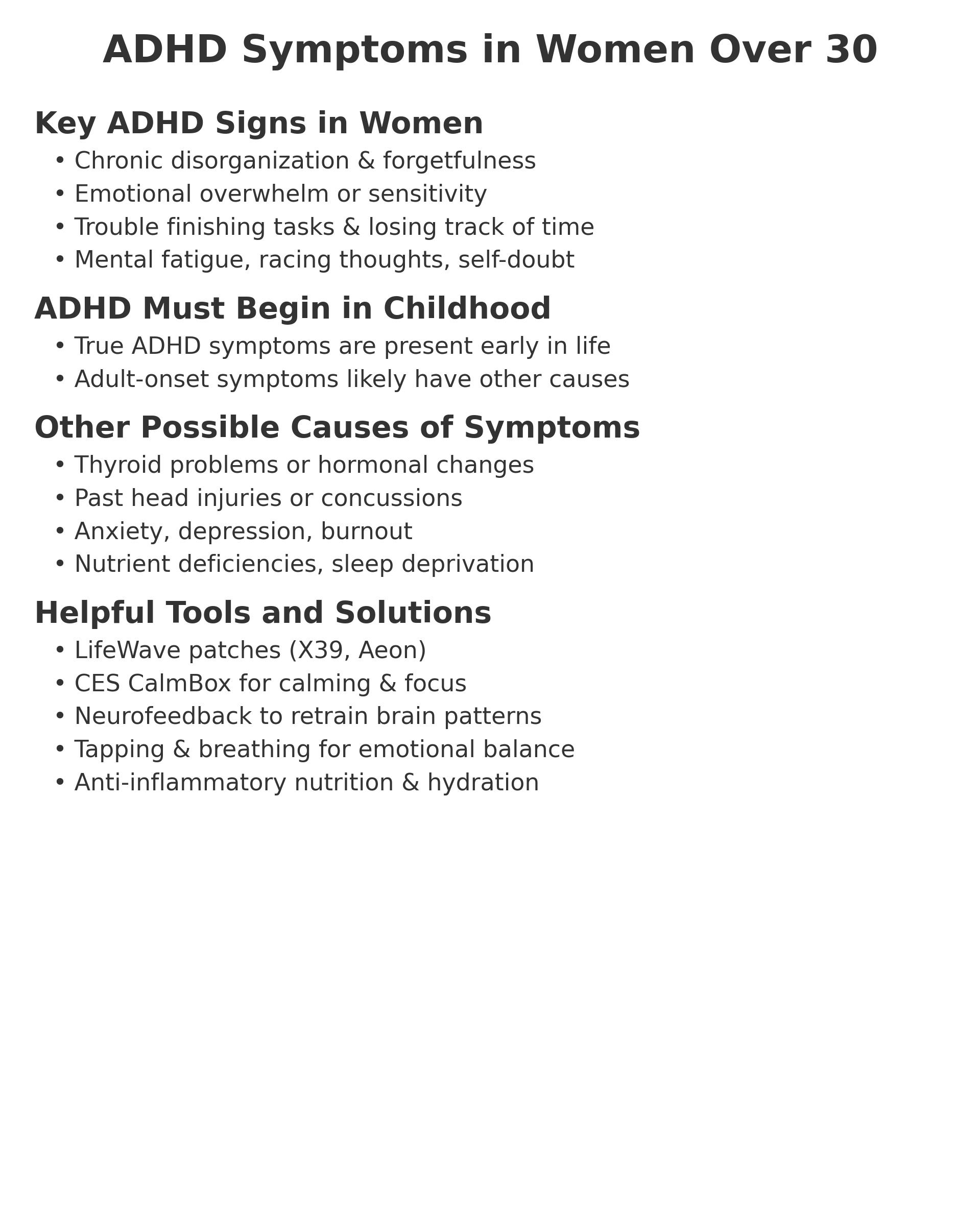
Chronic Disorganization That Resists Solutions
Not the kind of disorganization that a new planner or a better app can fix. The kind where the planner gets used for two weeks and then abandoned. Where systems get created and then forgotten. Where the kitchen counter is clear one day and buried the next.
This is executive function dysregulation — the brain’s management system running inconsistently. It is not a character flaw. It is the neurological substrate of ADHD. Understanding this distinction matters enormously, because women with ADHD have spent years treating it as a character flaw, and that treatment has not worked.
Emotional Overwhelm
The ADHD brain regulates emotions less efficiently than the neurotypical brain. This shows in adult women as: feeling quickly overwhelmed by demands that others seem to handle easily, rapid frustration that builds faster than expected, sensitivity to criticism that lands harder than intended, difficulty returning to baseline after emotional events.
Women with ADHD frequently describe feeling “too much” — too emotional, too sensitive, too easily undone. They have often been told to calm down, to be more rational, to not overreact. What they actually needed was an understanding that their emotional regulation system is running on the same compromised infrastructure as their attention regulation system.
Time Blindness
Dr. Russell Barkley describes this as one of the core deficits in ADHD: the inability to experience time the way most people do. The ADHD brain lives in “now” and “not now.” Future deadlines don’t feel real until they are immediate. Appointments that are three hours away feel as distant as appointments that are three days away.
In adult women, this produces: consistently running late despite genuine effort, chronic underestimation of how long tasks take, hyperfocus that absorbs hours while feeling like minutes, and the terrible shock of a deadline that was always there but somehow didn’t feel real until it was upon her.
Starting and Finishing
Many women with ADHD describe a pattern of big ideas and incomplete execution. Not because they lack follow-through in any moral sense, but because the neurochemical activation required to start and sustain effortful work is less reliably available in the ADHD brain.
This looks like: dozens of half-read books, started creative projects that stalled, a career full of potential that somehow hasn’t converted to the outcomes she knows she’s capable of. The gap between capability and performance is one of the most painful features of adult ADHD — and one of the most misunderstood.
The Shame Layer
By the time most women with ADHD are identified, they are carrying decades of the conclusions drawn from years of unexplained struggle: I’m scattered. I’m unreliable. I have so much potential and can’t get it together. Something is wrong with me.
Those conclusions are not accurate assessments. They are the predictable result of living with an undiagnosed neurological difference in a world that expected standard performance without providing standard tools.
Addressing the shame is not optional in treatment. It is often the central work.
What If It Isn’t ADHD?
Here is something important that I want to say directly.
ADHD is a neurodevelopmental condition. By definition, symptoms must have been present before age 12 — even if they were never recognized, even if no one ever used the word. If you genuinely had no attention or organizational difficulties until your 30s or 40s, ADHD is unlikely to be the explanation.
Several other conditions can produce ADHD-like symptoms in women at midlife:
Thyroid dysfunction, particularly hypothyroidism, produces fatigue, brain fog, difficulty concentrating, and mood changes that look remarkably like ADHD. A simple blood test can rule this in or out.
Perimenopause and hormonal shifts affect dopamine, serotonin, and cognitive function. Women in perimenopause commonly report new difficulty with focus, memory, and emotional regulation. This may be perimenopause, or it may be ADHD that was previously compensated and is now becoming visible as estrogen support for dopamine decreases.
Chronic stress and burnout produce executive function deficits that overlap significantly with ADHD — difficulty concentrating, emotional dysregulation, memory problems. The difference is that burnout symptoms remit with adequate rest and recovery; ADHD symptoms do not.
Anxiety and depression impair concentration and memory directly. If these are severe and untreated, they can make it very difficult to assess the underlying cognitive profile accurately.
Sleep deprivation or sleep apnea significantly impairs attention and executive function in anyone. Women with untreated sleep apnea can look, on a behavioral level, remarkably like someone with ADHD.
A comprehensive evaluation — one that looks at history, cognitive testing, lab work, and sleep — can sort out which of these factors are at play, or whether some combination of them is present alongside genuine ADHD.
What Helps
The good news is that adult ADHD in women is very treatable. Here is what the evidence and clinical experience support.
Medication. Stimulant medications work for many women with ADHD. Important note: some women find that their response to medication varies across the hormonal cycle, with less effectiveness premenstrually when estrogen drops. If this is your pattern, it is worth discussing with your prescribing doctor — it is real, it has a neurochemical explanation, and there are ways to address it.
ADHD coaching. This is different from therapy. ADHD coaching builds the practical daily systems — for planning, time management, task initiation, follow-through — that the ADHD brain lacks naturally. A good ADHD coach is like the external management system that the brain’s internal one is not providing.
Neurofeedback. For women who prefer a non-pharmaceutical approach or who want to reduce medication over time, neurofeedback trains the brain toward better self-regulation. Direct neurofeedback (LENS) in particular often produces faster initial changes and is accessible for people who find traditional neurofeedback difficult to sustain.
CES therapy. Cranial Electrotherapy Stimulation — specifically the CalmBox — addresses the anxiety-ADHD cycle that so many women are caught in. By calming the nervous system and improving sleep, CES reduces the anxiety load that is making the ADHD harder to manage.
Exercise. The most under-used tool in ADHD treatment for women. Consistent aerobic exercise raises dopamine and norepinephrine — the same neurotransmitters targeted by ADHD medication — with effects that last for hours and compound over time. Three to five sessions per week of 30 minutes is the target supported by research.
Addressing the shame explicitly. This is the work that many treatment approaches skip, and it is often what determines whether everything else sticks. A woman who understands what ADHD is and why she struggled — not because something was wrong with her, but because she was running a different operating system without the right support — can stop fighting herself and start working with herself.
The Bottom Line
If you have spent decades working harder than everyone around you and still coming up short in ways you cannot explain — the explanation may be simpler, and more hopeful, than you think.
ADHD is not a character flaw. It is a neurological pattern. It has been present since childhood, shaping your experiences in ways nobody named. And it is one of the most treatable conditions in mental health — at any age.
You are not scattered. You are not unreliable. You are not a person who can’t get it together.
You are a person whose brain works differently — and who has been working twice as hard as everyone else without understanding why.
Imagine what becomes possible when the work is supported by understanding, and the understanding comes with a plan.
Let’s move forward.
Related Resources
- Adult ADHD Self-Report Scale (ASRS v1.1)
- ADHD in Girls: The Signs Nobody Talks About
- Adult ADHD Symptoms: Why It Looks Different Than You’d Expect
- The Six Types of ADHD
- Work With Dr. Cowan
References
-
Quinn, P.O., & Madhoo, M. (2014). A review of attention-deficit/hyperactivity disorder in women and girls: Uncovering this hidden diagnosis. Primary Care Companion for CNS Disorders, 16(3). PubMed
-
Rucklidge, J.J. (2010). Gender differences in attention-deficit/hyperactivity disorder. Psychiatric Clinics of North America, 33(2), 357–373. PubMed
-
Young, S., et al. (2020). Females with ADHD: An expert consensus statement taking a lifespan approach providing guidance for the identification and treatment of attention-deficit/hyperactivity disorder in females of all ages. BMC Psychiatry, 20, 404. PubMed
-
Barkley, R.A. (2015). Attention-Deficit Hyperactivity Disorder: A Handbook for Diagnosis and Treatment (4th ed.). Guilford Press.
-
Nussbaum, N.L. (2012). ADHD and female specific concerns: A review of the literature and clinical implications. Journal of Attention Disorders, 16(2), 87–100. PubMed
-
Nadeau, K.G., Littman, E., & Quinn, P.O. (2015). Understanding Girls with ADHD (Updated and Revised). Advantage Books.
-
Duerden, E.G., et al. (2012). Sex differences in ADHD: Examining the phenotypic heterogeneity. Journal of Psychiatric Research, 46(7), 849–856. PubMed
Frequently Asked Questions
Can ADHD first appear in women in their 30s or 40s?
ADHD is a neurodevelopmental condition — symptoms must have been present before age 12, even if never recognized. What changes in the 30s and 40s is not the ADHD itself but the circumstances: increased demands, hormonal shifts, perimenopause, burnout. New focus problems in midlife may also signal thyroid issues, hormone imbalance, or sleep apnea — a proper evaluation rules these out.
Why is ADHD in adult women so often misdiagnosed as anxiety or depression?
Women with ADHD are more likely to internalize — blaming themselves, developing anxiety from years of struggling without explanation, and presenting with depression that is secondary to the unmanaged ADHD. Clinicians who are not specifically trained in ADHD in women may see only the anxiety or depression and miss the underlying attention regulation issue driving both.
What does ADHD look like in adult women?
In adult women, ADHD typically shows as chronic disorganization, emotional overwhelm, time blindness, difficulty finishing projects, forgetting appointments despite best intentions, impulsive spending or talking, difficulty with transitions, and a persistent sense of falling short despite working harder than anyone around them. Shame is almost universal.
How is ADHD in adult women treated?
Effectively — with the right approach. Medication is helpful for many women and may need adjustment around hormonal cycles. ADHD coaching builds the practical systems that medication alone doesn't provide. Neurofeedback, CES therapy, exercise, and sleep optimization all support brain regulation. Addressing the shame and the accumulated self-narrative of failure is often as important as any clinical intervention.