By Dr. Douglas Cowan, Psy.D., MFT
I have been a marriage and family therapist for forty years. I have sat with hundreds of couples in offices and living rooms and crisis moments. And I can tell you without hesitation: an ADHD marriage is not a doomed marriage. But it is a marriage that requires understanding the specific forces working against it — and building specific tools to counteract them.
This is not the article that explains why ADHD makes marriage hard. We have another article for that. This is the article for couples who already know it's hard and want to know what to actually do.
Everything here comes from four decades of clinical work, from Gottman's research on what makes marriages succeed, from my own five-year journey through unforgiveness in my own marriage, and from the conviction that runs through everything I do: freedom is the goal, and freedom is available to every couple willing to reach for it.
What's Happening in the Brain
To thrive in an ADHD marriage, both partners need to understand one neurological reality clearly.
The brain has two main operating centers relevant to marriage. The prefrontal cortex — the seat of planning, empathy, emotional regulation, working memory, and impulse control — is where our best selves live. Our patience, our thoughtfulness, our ability to repair a conversation rather than escalate it — all of that lives here.
The limbic system — the seat of fear, anger, and threat response — is where our worst moments live. When we feel criticized, rejected, flooded, or exhausted, the limbic system takes over and the prefrontal cortex goes offline.
The goal of a healthy marriage is to keep both people operating from their prefrontal cortex as often as possible — and to have the tools to return there quickly when the limbic system has seized control.
In an ADHD marriage, the prefrontal cortex of the ADHD partner is already underperforming at baseline. Add marital stress, and the system degrades further. The non-ADHD partner, carrying disproportionate mental and logistical load, is also running closer to the edge than they realize. Both people are more vulnerable to limbic hijacking than they would be in a neurotypical marriage.
This is not an excuse. It is a map. And a map is only useful if you use it.
Now You Understand Why
This is why the same conversation keeps happening. Not because either partner is bad or unwilling — because the conversation keeps triggering the limbic system before the prefrontal cortex can respond.
This is why the non-ADHD partner feels more like a parent than a spouse. When one person is managing the calendar, the finances, the logistics, and the emotional environment for two people, the relationship structure changes shape whether anyone intends it to.
This is why the ADHD partner often feels criticized no matter what they do. Rejection Sensitive Dysphoria — an intense, neurologically-based sensitivity to perceived disapproval — is common in ADHD and makes ordinary feedback feel like an attack. When that response is active, defensiveness follows automatically.
And this is why Gottman's research applies with particular force to ADHD marriages. His four patterns that predict divorce — criticism, contempt, defensiveness, and stonewalling — are exactly what happens when two exhausted people with a miscommunication problem try to solve it while both operating from their limbic systems.
The solution is not better arguments. The solution is better conditions for conversation — and better tools for returning to connection when things go wrong.
What Wisdom Looks Like Here
John Gottman spent decades studying what makes marriages succeed. His conclusion is counterintuitive and important: the goal is not to resolve conflict. Most marital conflict — he estimates 69% — is perpetual. It cannot be resolved. The couples who thrive are not the ones who solve everything. They are the ones who build enough positive connection that the unresolvable differences stop being threatening.
What builds that connection? Five hours a week. That's it. Small, consistent investments: a real goodbye in the morning, a conversation at the end of the day that isn't about logistics, daily appreciation expressed out loud, physical affection, and a weekly date focused on connection rather than problem-solving.
Five hours a week changes the emotional baseline of a marriage. It does not eliminate the hard conversations. It gives those conversations a different atmosphere to happen in.
For an ADHD marriage, this framework is not just helpful. It is essential. Because the hard conversations will keep coming — the forgotten commitment, the missed deadline, the emotional flooding, the exhaustion. What determines whether those moments damage the marriage or don't is the strength of the foundation underneath them.
Build the foundation. The conflicts become manageable when the connection is real.
What To Do Starting Today
Build your love map — and keep building it. Gottman calls this principle the foundation of everything else. A love map is your detailed knowledge of your partner's inner world — their current stresses, their fears, their hopes, their daily life. In ADHD marriages, this map gets neglected because the operational demands of managing logistics crowd out the deeper conversations. Make it a deliberate practice. Ask one real question per day. Not "how was work" — something more specific: "What's the hardest part of your week right now?" "Is there something you're worried about that we haven't talked about?" Intimacy is built in these small moments of genuine curiosity.
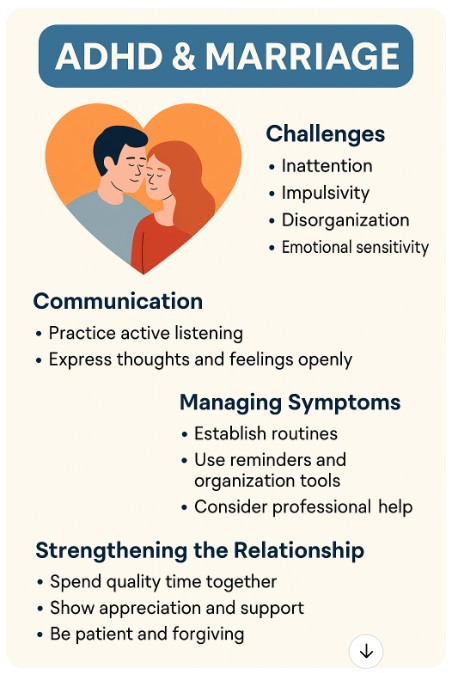
Replace the Four Horsemen with their antidotes — specifically. Criticism (attacking the person rather than the behavior) → Gentle complaint with "I" statements. "I feel overwhelmed when the bills aren't paid on time" instead of "You never deal with anything." Contempt (the most damaging of all — sarcasm, eye-rolling, mockery) → Active appreciation. You cannot be contemptuous of someone you are genuinely cherishing. Practice noticing and naming what your partner does right. Defensiveness (deflecting responsibility) → Taking ownership, even partial ownership. "You're right that I forgot. That's on me." Stonewalling (emotional withdrawal) → Agreed-upon pauses. When the conversation is going nowhere, the answer is not to push through — it is to pause, self-regulate, and return. "I need twenty minutes. I'm not leaving this. I'll be back."
Learn the STAR method for ADHD-specific conflict. When ADHD-fueled emotions escalate, use this sequence: Stop the confrontation the moment you notice escalation — before either person says something that can't be unsaid. Think during the break — not about who is right, but about what each person is actually feeling and needing. Act when both people are regulated — return to the conversation with curiosity rather than defensiveness. Recover by naming what happened and what you want to do differently next time. This is not conflict avoidance. It is conflict wisdom.
Build appreciation into every day — deliberately, specifically, out loud. Gottman's research finds that the ratio of positive to negative interactions in a marriage needs to be at least five to one for the relationship to remain stable. In an ADHD marriage, the negative interactions tend to accumulate faster than in neurotypical marriages — the forgotten things, the missed signals, the exhaustion. Which means the positive interactions need to be more intentional, not less. Tell your spouse one specific thing you appreciate about them every day. Not general — specific. "I noticed you handled that phone call really well today." This is not flattery. It is relationship maintenance.
Address Rejection Sensitive Dysphoria directly. The ADHD partner needs to know: your sensitivity to criticism is neurological, not weakness. It is real and it is disproportionate to what is actually happening. Build a signal with your spouse — a word or gesture that means "I am not attacking you, I am trying to reach you." Practice receiving feedback in low-stakes moments so the skill exists when high-stakes moments arrive. The non-ADHD partner needs to know: the way you phrase things matters enormously. The same information delivered with warmth and with frustration lands completely differently in a brain with RSD. Lead with connection before correction.
Build external systems together — and protect them. Working memory is not reliable in ADHD. That is not a character flaw. It is a neurological reality that requires external solutions. A shared digital calendar with alerts for both partners. A brief Sunday evening review of the week ahead — fifteen minutes, not a production. Written agreements about who owns which household responsibilities. These are not signs that the marriage is in trouble. They are intelligent adaptations to how one of the brains in the marriage actually works. The non-ADHD partner is not doing the ADHD partner's thinking for them. They are building a system that allows the ADHD partner to succeed.
Practice forgiveness as a regular discipline — not a one-time event. Every marriage accumulates hurt. In an ADHD marriage, the hurt accumulates faster because the failures are more frequent and more visible. Forgiveness is not minimizing the hurt. It is not pretending it didn't happen. It is not condoning behavior that needs to change. Forgiveness is cutting the bungee cord that snaps you back to the moment of injury every time you try to move forward. It is releasing the debt so that the relationship can have a future that isn't defined by the past. This is something I know personally — I spent five years working through my own unforgiveness, and I can tell you that the freedom on the other side of it is real. It takes time. It takes honesty. It takes help. But it is available to every couple willing to do the work.
Seek help from a therapist who understands both ADHD and marriage. This is not optional if the marriage is under significant strain. An ADHD-informed couples therapist can help both partners see clearly — not just understand ADHD intellectually, but work through the specific relational patterns that ADHD has created. Individual counseling for the ADHD partner builds the skills that ADHD prevented from developing naturally. Individual support for the non-ADHD partner addresses the burnout, resentment, and grief that accumulates from years of carrying disproportionate load. Together, therapy and coaching give the marriage the professional support it deserves.
Create shared meaning — on purpose. Gottman's seventh principle is the deepest one: thriving couples build a shared culture of rituals, values, goals, and symbols that give their marriage meaning beyond the daily logistics. In an ADHD marriage, this often gets lost in the operational demands. Reclaim it deliberately. A recurring date night. A family ritual around meals or weekends. A shared goal you're working toward. A shared faith, if that is part of your life. Couples who know what their marriage is for — beyond just surviving — have a reason to keep building it even when things are hard.
I have watched couples come back from places that seemed impossible. I have seen trust rebuilt where it appeared completely gone. I have seen marriages that were years into negative sentiment override — where every interaction was filtered through disappointment and hurt — turn around when both partners decided that the marriage was worth fighting for and got the right help.
ADHD is real. The challenges it brings to marriage are real. And so is the marriage that is possible on the other side of those challenges.
The door is open. Walk through it together.