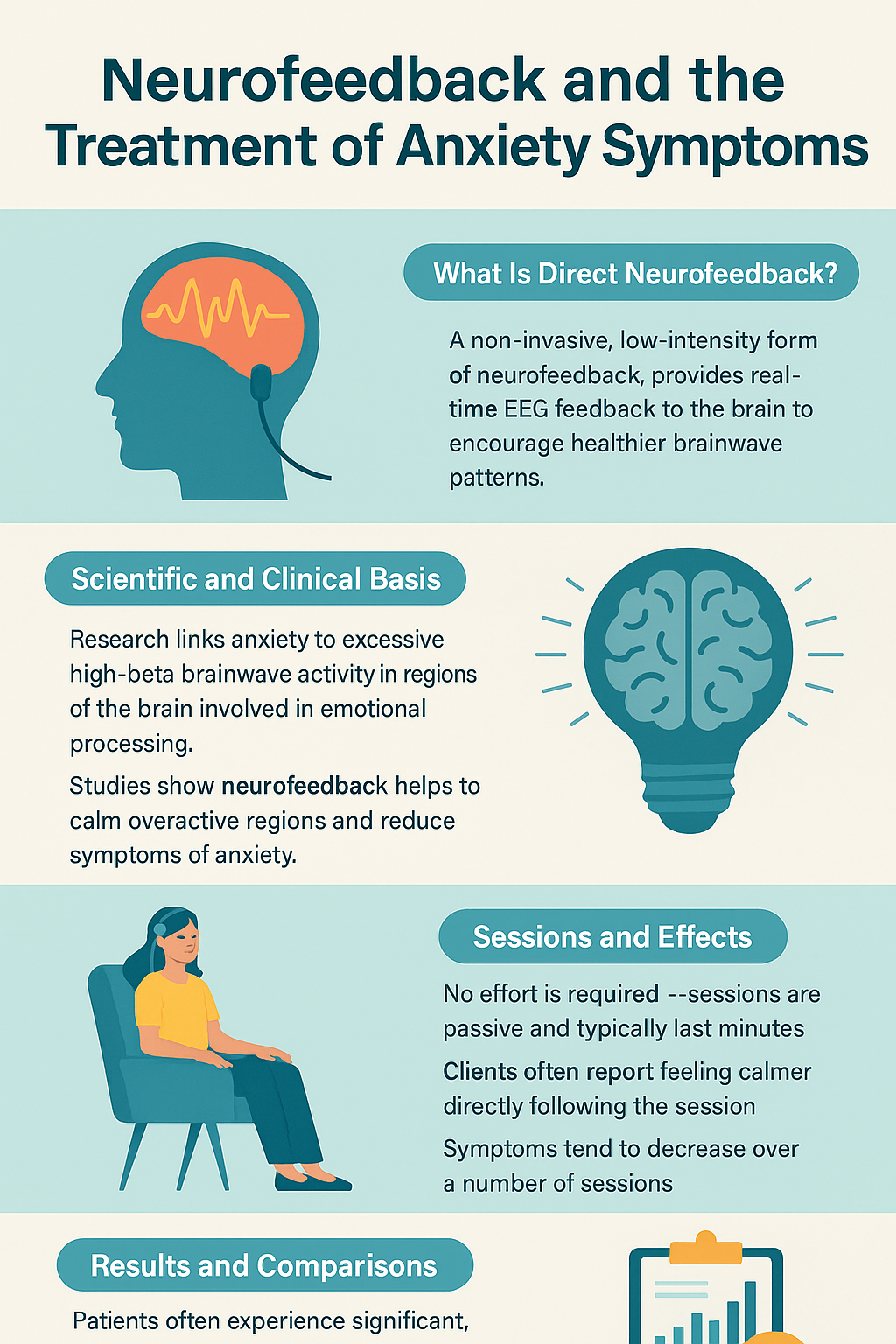
How Direct Neurofeedback Helps with Anxiety
- How does neurofeedback help with anxiety — and how is it different from therapy or medication?
- What is Direct Neurofeedback and is there research behind it?
By Dr. Douglas Cowan, Psy.D., MFT
I’ve worked with neurofeedback for thirty-five years. In that time I’ve sat with people who had tried medication, therapy, meditation, and every combination of them — and were still anxious. Not because they weren’t trying. Because anxiety, at its most persistent, is not primarily a thinking problem. It’s a brain regulation problem. And you can’t think your way out of a regulation problem.
What Direct Neurofeedback does — gently, and without requiring the client to do anything — is give the brain an opportunity to reset. I’ve watched it help people who had been stuck for years. That doesn’t mean it works for everyone, or that it’s the only tool worth reaching for. But it is worth understanding, especially for the people who’ve already tried the standard routes and found them insufficient.
What’s Happening in the Brain
Anxiety is not a character flaw. It’s the brain’s alarm system — the amygdala — running too hot, too often, or stuck in the on position when there is no current threat.
Under normal conditions, the amygdala fires in response to genuine danger and then quiets down once the threat has passed. The prefrontal cortex — the rational, executive part of the brain — helps regulate that response, putting it in context and bringing the alarm system back to baseline. In chronic anxiety, this regulatory loop breaks down. The amygdala remains hyperactive. The prefrontal cortex loses its ability to effectively override the alarm. The brain gets locked into high-frequency beta and high-beta brainwave patterns associated with rumination, hypervigilance, and panic.
This is a physiological state, not a cognitive one. The anxious brain is not making a mistake in its thinking — it’s operating within a dysregulated electrical pattern. And that’s the level at which Direct Neurofeedback works.
Direct Neurofeedback (also called microcurrent neurofeedback or low-energy neurofeedback) delivers a tiny, precisely calibrated electrical signal — in the pico- to microamp range — through electrodes placed on the scalp. The signal is subthreshold, meaning it doesn’t force the brain to do anything. What it does is briefly interrupt maladaptive neural circuits, giving the brain’s own plasticity an opening to reorganize toward a more regulated state. The process leverages something the brain already knows how to do — it just needs a nudge out of the stuck pattern.
This is meaningfully different from traditional operant neurofeedback, which works through conscious conditioning over thirty to sixty sessions. Direct Neurofeedback is passive. The client sits quietly. Sessions take about twenty to thirty minutes. Most people feel relaxed afterward, sometimes briefly tired. The cumulative effect across sessions builds a new, calmer baseline.
Now You Understand Why
When you understand that anxiety is a stuck brainwave pattern as much as it is a thought pattern, the limitations of purely cognitive approaches make sense.
CBT and talk therapy work with the prefrontal cortex — the thinking, reasoning, interpreting brain. They are effective, and they have a strong evidence base. But for people whose anxiety is rooted in physiological hyperarousal — particularly trauma survivors, people with panic disorder, or those whose nervous systems have been running hot for so long that cognitive reframing barely touches the underlying state — top-down approaches can only reach so far. The problem is downstream from where the words land.
This is why some people do years of therapy and still feel anxious. Their insight grows, their understanding deepens, and yet the physical experience of anxiety persists. What they often need is a bottom-up approach — something that works through the body’s own electrical system rather than through thought restructuring.
Direct Neurofeedback is one of those bottom-up approaches. It works particularly well for individuals who have been “stuck” despite other interventions, for people whose anxiety has a strong somatic component (chest tightness, racing heart, physical hypervigilance), and for children and trauma survivors who may not be able to tolerate the cognitive demands of traditional therapy or the side effects of medication.
A 2024 clinical study comparing two EEG-based neurofeedback protocols for generalized anxiety disorder found significant reductions in anxiety severity, state anxiety, trait anxiety, and perceived stress — confirming what clinicians who use neurofeedback have observed for decades. A 2025 meta-analysis in Frontiers in Neuroscience found neurofeedback reduced PTSD symptoms with a high quality of evidence rating. A 2025 randomized controlled trial combined neurofeedback with mindfulness and showed amplified anxiety reduction over either approach alone. The evidence base is growing, and it’s maturing toward stronger clinical confidence.
One honest note: some research has raised the question of whether improvements from neurofeedback are partly attributable to the relaxation and attention involved in the sessions rather than the brainwave regulation itself. This is a fair point, and it’s worth holding. What I can say from thirty-five years of clinical practice is that the outcomes I see in clients go beyond what relaxation alone would produce — particularly in people who have been unable to relax by any other means.
What Wisdom Looks Like Here
The question to ask is not “which treatment is best?” It’s “which approach fits this particular brain, this particular history, and this particular pattern of symptoms?”
Direct Neurofeedback fits best when anxiety is persistent despite other interventions, when it has a strong physical/somatic component, when medication has been unhelpful or unwanted, or when the person’s window of tolerance for cognitive or emotional processing is narrow. It is also highly compatible with other approaches — it can be combined with CBT, medication, breathing practices, and CES without conflict. Many clients find that neurofeedback lowers the baseline enough that therapy becomes more productive.
What it requires is realistic expectations and patience. Most people notice changes within three to five sessions, but the full course of care typically runs ten to twenty sessions. Some clients benefit from occasional maintenance sessions after the primary course. Results are not dramatic in the way a medication response can be — they tend to be described as a gradual shift, a quieting of the background noise, a new baseline that feels different from the inside.
That quieter baseline is what I’m after for every person I work with. Not the absence of feeling — that’s not the goal. The goal is a nervous system that can respond to life without being overwhelmed by it. Freedom from the alarm that keeps going off when there’s nothing actually wrong.
What To Do Starting Today
-
Understand what you’re working with before you choose an approach. Not all anxiety is the same. Generalized anxiety disorder, panic disorder, social anxiety, trauma-based anxiety, and anxiety that travels alongside ADHD each have different profiles and respond differently to different interventions. A proper clinical assessment — including a thorough history and, where appropriate, a qEEG brain map — gives you a clearer picture of what the brain is actually doing and which approaches are most likely to help.
-
Ask about Direct Neurofeedback if standard approaches haven’t been enough. If you or someone you care about has been through therapy, tried medication, and still hasn’t found lasting relief from anxiety, neurofeedback — and particularly Direct Neurofeedback — is worth a serious conversation with a qualified provider. Ask about their training, the system they use, and what realistic expectations look like for your specific situation.
-
Look for providers who combine approaches. The most effective anxiety treatment plans tend to be multimodal — addressing the nervous system physiologically (through neurofeedback, CES, exercise, or breathing practices) while also building cognitive and relational skills. Providers who understand both the neurological and the psychological dimensions of anxiety tend to get better outcomes than those working within a single modality.
-
Give it adequate time. Neurofeedback is not a quick fix. The ten-session mark is where most people begin to notice sustained changes. The twenty-session range is where those changes typically consolidate. Committing to the full course of care — rather than stopping after a few sessions — makes a significant difference in outcomes.
-
Track your progress. Keep a simple daily rating of your anxiety level — a one-to-ten number, at the same time each day. This creates a baseline and lets you and your provider see objectively whether the approach is working over time. What often happens is that the improvements are gradual enough that people don’t notice them without a record to compare against.
The anxious brain is not broken. It is stuck — in a pattern it learned for reasons that made sense at the time, operating in a mode that has outlasted its usefulness. Direct Neurofeedback gives the brain permission to let that pattern go. That’s a gentler intervention than it might sound, and for many people, a more effective one than anything else they’ve tried.
Freedom is the goal. The alarm can quiet down. Let’s find the right tools to help it.
References
- Marzbani, H., Marateb, H. R., & Mansourian, M. (2016). Neurofeedback: A comprehensive review on system design, methodology, and clinical applications. Basic and Clinical Neuroscience, 7(2), 143–158.
- Ros, T., et al. (2020). Consensus on the reporting and experimental design of clinical and cognitive-behavioral neurofeedback studies (CRED-nf checklist). Brain, 143(6), 1674–1685.
- Banerjee, S., et al. (2024). Comparing the efficacy of two EEG-based neurofeedback protocols for generalized anxiety disorder: Sensory motor rhythm and alpha-theta. Iranian Journal of Psychiatry and Behavioral Sciences, 18(1).
- Coventry, P., et al. (2025). Systematic review and meta-analysis of neurofeedback training efficacy and neural mechanisms in the treatment of PTSD. Frontiers in Neuroscience, 19, 1658652.
- Hammond, D. C. (2005). Neurofeedback treatment of depression and anxiety. Journal of Adult Development, 12(2–3), 131–137.
- Collura, T. F., et al. (2020). Clinical use of microcurrent neurofeedback with subtypes of anxiety disorders. Journal of Neurotherapy, 14(1), 1–22.