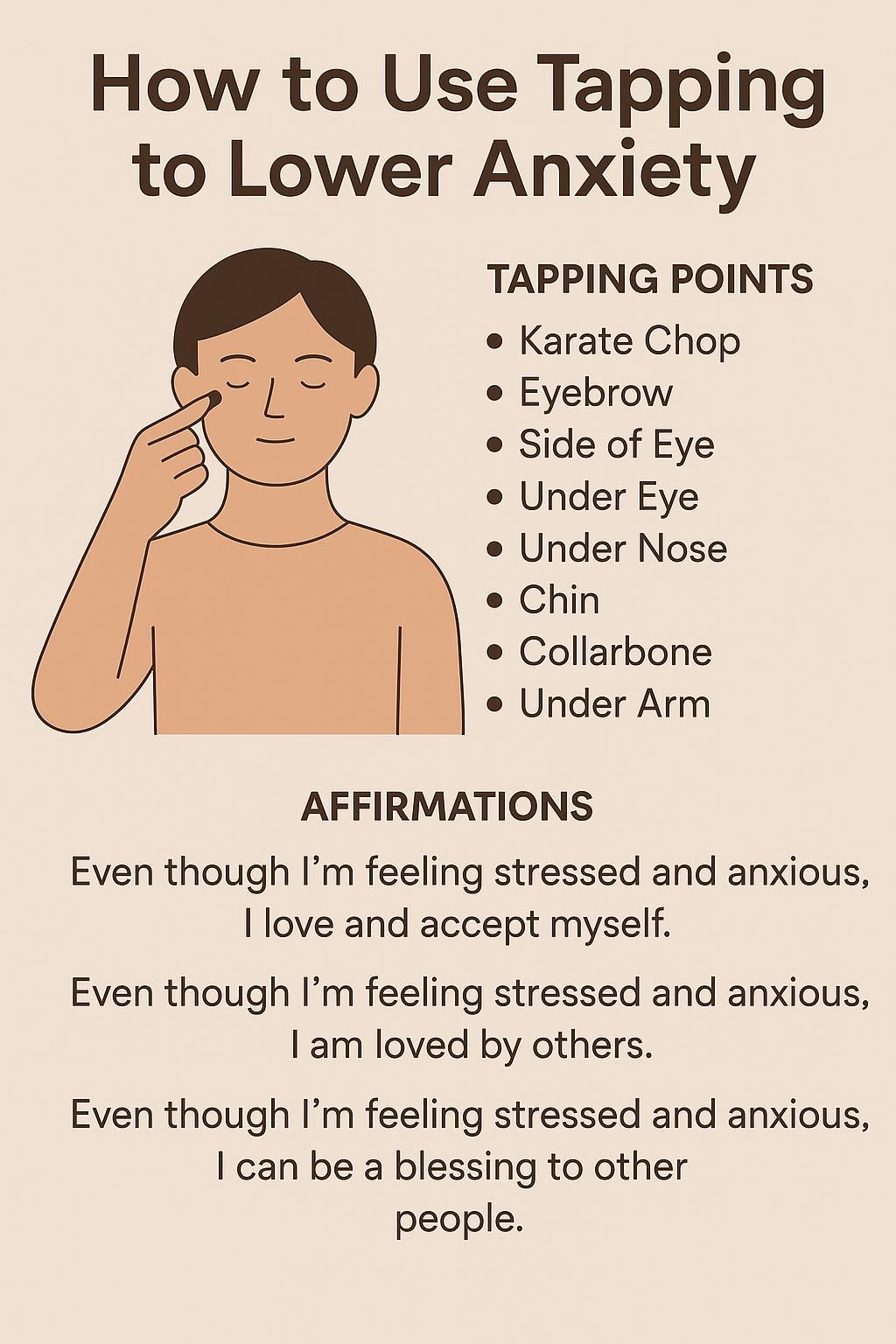
How to Use Tapping to Lower Anxiety
- Does EFT tapping really work for anxiety? - How do I do tapping for anxiety — step by step?By Dr. Douglas Cowan, Psy.D., MFT
Where is the control in your life? Is it within you — or does it feel like the world is constantly acting upon you?
That question — what therapists call locus of control — is at the heart of anxiety. The anxious person experiences themselves as subject to forces they cannot manage: the worry comes whether they want it or not, the racing heart starts without permission, the dread arrives before the situation has even fully formed. Anxiety is, among other things, the experience of feeling out of control.
The practice I want to share with you today returns something to you. It is called Emotional Freedom Technique, or EFT — sometimes called tapping. It is a self-regulation tool you can use anywhere, in ten minutes, that calms the amygdala, lowers cortisol, and shifts the nervous system out of fight-or-flight. And it gives you back a sense of agency — which is one of the most therapeutic things you can experience when anxiety has been running the show.
I'll be honest: it looks strange. You tap on specific points on your face, hands, and chest while saying particular phrases. The first time someone demonstrates it, the reaction is almost always skepticism. But the research on this is solid, and the clinical results across four decades of practice are real. Give it a fair trial before you decide.
What's Happening in the Brain
EFT tapping works through two simultaneous mechanisms, and understanding both helps explain why it is more effective than either component alone.
The first mechanism is acupressure. The tapping points used in EFT correspond to endpoints of cranial nerve pathways — points that, when stimulated, send sensory signals directly through the parasympathetic nervous system. Gentle rhythmic tapping at these points activates sensory nerves that feed into the vagal pathway, shifting the autonomic system toward parasympathetic (rest-and-digest) dominance and calming the amygdala's alarm response. This is body-first regulation: you are using the body to change the brain state before the thinking mind has to do anything.
The second mechanism is combined cognitive and emotional focusing. While tapping, you hold conscious attention on the distressing feeling — naming it, acknowledging it, staying with it rather than avoiding it — while simultaneously affirming acceptance and worth. This combination of focused attention on the distress with a paired affirmation of self-worth appears to interrupt the amygdala's threat-processing loop in a specific way that standard cognitive approaches don't replicate.
The research on tapping has matured significantly. A 2024 review and meta-analysis of randomized controlled trials found EFT significantly reduced cortisol levels — by an average of 43% in one well-controlled study — and decreased self-reported anxiety scores, with effect sizes comparable to Cognitive-Behavioral Therapy and with faster onset of effect in some presentations. A 2019 systematic review published in the Journal of Evidence-Based Integrative Medicine reviewed 20 randomized controlled trials and found consistent significant reductions in anxiety, depression, and PTSD symptoms.
In neuroimaging research, EFT has been shown to reduce activity in the amygdala and hippocampus during activation of distressing memories — which means the brain processes the stressor differently after tapping than before. This is not a placebo response; it is a measurable neurological change.
Now You Understand Why
Why does combining the physical tapping with verbal acknowledgment and affirmation work better than either alone?
Because anxiety involves two things at once: a physiological state (elevated cortisol, sympathetic activation, amygdala hyperarousal) and a cognitive-emotional pattern (the belief that the threat is real, the story around the feeling, the meaning assigned to the distress). Medication addresses only the first. Pure talk therapy primarily addresses only the second.
EFT touches both simultaneously. The tapping calms the physiological state through the body's sensory pathways. The verbal component — acknowledging the feeling honestly while affirming acceptance and worth — interrupts the cognitive-emotional loop. Neither has to wait for the other to go first.
This is also why tapping works particularly well for people whose anxiety is rooted in shame or self-criticism. The core affirmation of EFT — "Even though I feel [this thing], I deeply and completely accept myself" — is not just a calming statement. It is a direct challenge to the lie that the anxious brain most commonly runs: I am broken. I am defective. Something is wrong with me. Repeating acceptance alongside the acknowledgment of distress begins to pry those two things apart. You can feel anxious and be okay. The feeling is not the verdict.
Faith deepens this further. When the affirmation includes an acknowledgment of being loved by God — "I am loved by God, I am loved by others, I can be a blessing to the world today" — it grounds the self-acceptance not in the person's own performance or merit but in something more stable. In my practice, I have found that clients who incorporate this dimension of the affirmation reach the calming effect more quickly and more deeply.
What Wisdom Looks Like Here
Two practical points before the sequence:
First, tapping works best when practiced before you need it. The nervous system learns patterns through repetition. If you only use tapping in moments of acute crisis, you'll find it hard to remember the sequence and easy to dismiss it. If you practice it daily — even when your anxiety is mild — the pattern becomes automatic, and it becomes accessible exactly when you need it most.
Second, give it at least five rounds before you evaluate whether it's working. The first round begins the physiological shift; subsequent rounds consolidate it. Most people notice meaningful reduction in their anxiety rating by rounds three to five.
The Tapping Sequence
Before you begin, rate your anxiety on a scale of 0 to 10. Write the number down. This gives you an objective marker to compare against when you finish.
Step 1 — Take responsibility. Say aloud: "I take full and complete responsibility for myself and my life." This is not about blame — it is about ownership. It reclaims the locus of control.
Step 2 — The setup statement. Using two fingers, tap the outer edge of one hand (the fleshy side, the "karate chop" point) while saying three times: "Even though I feel stressed and overwhelmed right now, I can love and accept myself. I am loved by God. I am loved by others. I can be a blessing to the world today."
Say it as if you mean it. Say it even if you don't believe it fully yet.
Step 3 — Tap through the sequence. Tap each of the following points five to ten times with two fingers, gently but firmly, while repeating a short reminder phrase — "this anxiety," "this stress," "this feeling in my chest," or whatever names the specific distress you're working with. Work through the points in order:
- Top of the head — crown, center
- Inner eyebrow — where the eyebrow begins, near the nose
- Side of the eye — outer corner, on the bone
- Under the eye — on the orbital bone, directly below the pupil
- Under the nose — between the nose and upper lip
- Chin point — the indentation below the lower lip
- Collarbone — about one inch below the collarbone notch, on either side
- Under the arm — about four inches below the armpit, along the side of the rib cage
- Side of the thumb — outer edge, at the base of the thumbnail
- Side of the index finger — outer edge, at the base of the fingernail
- Side of the middle finger — outer edge, at the base of the fingernail
- Side of the little finger — outer edge, at the base of the fingernail (skip the ring finger)
- Inside of the wrist — pulse point area, both wrists together
Step 4 — Shift the statement. On your second or third round of the sequence, begin replacing the distress-focused reminder phrase with statements of intention and worth. Some examples:
- "I can handle what is in front of me today."
- "I can be a blessing to others."
- "I am safe right now, in this moment."
- "I can move forward."
After completing two to three rounds, rate your anxiety again. Most people find it has dropped two to four points. Some find it drops to zero. If it has moved at all, continue until it plateaus — then decide whether another issue needs its own round.
What To Do Starting Today
-
Use tapping in the morning before a stressful day begins. Five minutes of tapping before the day's pressure arrives is worth far more than ten minutes of tapping after the anxiety has already peaked. Morning tapping lowers the baseline before the first demands land.
-
Use it in the car before a difficult meeting or conversation. Thirty seconds of the setup statement and one quick round through the sequence can shift your state before you walk through the door.
-
Use it at night to release what the day accumulated. Anxiety often peaks in the evening as the nervous system finally processes what was suppressed during the day's demands. Tapping before sleep can interrupt the rumination cycle and make rest more accessible.
-
Use it anytime the anxiety number is above a five. You don't need a special setting or privacy. The sequence can be done subtly — tapping the side of the hand under a desk, pressing on the fingernail points with the opposite thumb. Once the pattern is learned, it can be practiced anywhere.
-
Teach it to someone you care about. Tapping is one of the most transferable self-regulation tools I know. Parents can do it with anxious children. Spouses can do it together. Teaching it is itself an act of care.
Anxiety says: you are at the mercy of this feeling. Tapping says otherwise. It is a small practice with a large effect — not because it is magic, but because it works through real neurological pathways that are always available and always responsive. The control that anxiety steals, tapping returns.
Try it once. Then try it again tomorrow.
References
- Church, D., et al. (2024). Emotional Freedom Techniques for anxiety: A systematic review and meta-analysis of randomized controlled trials. Frontiers in Psychology, 15, 1408.
- Bach, D., et al. (2019). Clinical EFT (Emotional Freedom Techniques) improves multiple physiological markers of health. Journal of Evidence-Based Integrative Medicine, 24, 2515690219853940.
- Clond, M. (2016). Emotional Freedom Techniques for anxiety: A systematic review with meta-analysis. Journal of Nervous and Mental Disease, 204(5), 388–395.
- Church, D., et al. (2012). Single session reduction of the intensity of traumatic memories in abused adolescents after EFT: A randomized controlled pilot study. Traumatology, 18(3), 73–79.
- Fang, J., et al. (2017). The salient characteristics of the central effects of acupuncture needling: Limbic-paralimbic-neocortical network modulation. Human Brain Mapping, 30(4), 1196–1206.
- Stapleton, P., et al. (2020). Neural changes after EFT treatment for food cravings. Complementary Therapies in Clinical Practice, 39, 101122.