Anxiety

Anxiety and the Emotional Brain: A Plain-Language Overview

Search questions:

Here's something I say to almost every new client who sits across from me in my office: "We are the descendants of scared people."

It always lands. Because it's true, and because it changes something in how people relate to their anxiety.

Think about it. For hundreds of thousands of years, the humans who survived were the cautious ones — the ones whose brains stayed alert, scanned for danger, and responded quickly when threat appeared. The bold ones, the ones who didn't worry, often didn't survive long enough to have children. Our lineage is, literally, a lineage of anxious people. Their caution kept them alive. And their brains are now ours.

That doesn't mean we're stuck with the anxiety. It means we understand where it comes from. And understanding is always the first step toward something better.

What's Happening in the Brain

Anxiety is not a thought problem that happens to affect the body. It's a brain-state that produces thoughts as a byproduct. The distinction matters, because it tells us where the intervention needs to start.

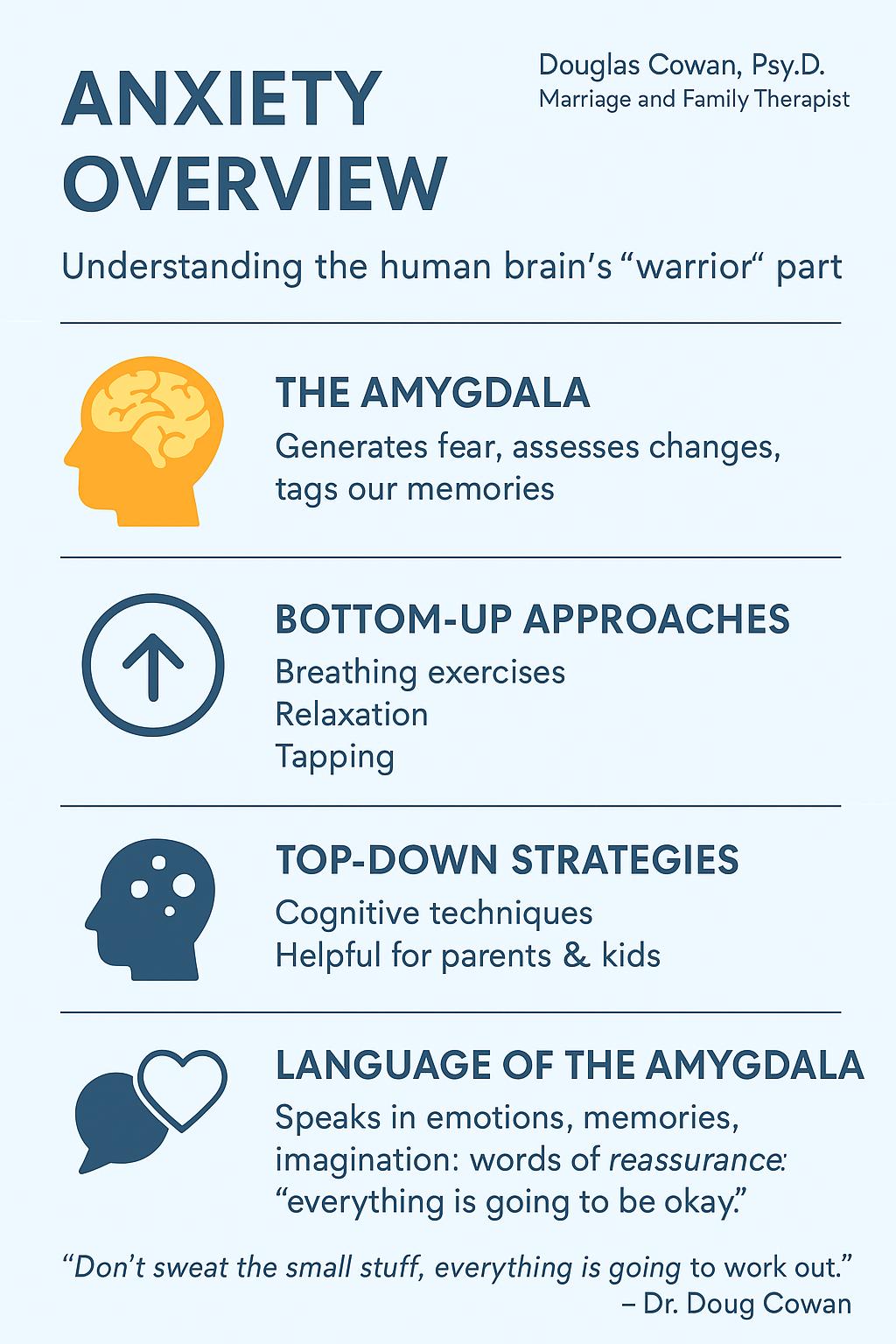
Deep in the brain — beneath your conscious awareness, beneath your reasoning and language and planning — sits the limbic system: a collection of ancient structures that govern emotional response, memory, and survival behavior. The star player in anxiety is the amygdala, a small, almond-shaped cluster of neurons that functions as the brain's smoke alarm.

The amygdala works fast. When it detects something that pattern-matches to danger — a tone of voice, a visual cue, a memory, a physical sensation — it fires before you've had a single conscious thought. It sends an emergency signal to the hypothalamus, which activates the body's stress response. Cortisol and adrenaline flood the system. Heart rate accelerates. Breathing shallows. Muscles tense. Digestion pauses. Everything in the body orients toward one priority: survive.

The prefrontal cortex — the rational, analytical brain — is supposed to evaluate the amygdala's assessment and provide context. When it's working well, it sends a signal: That noise was a car backfiring, not a gunshot. Stand down. But when stress is high, when trauma is present, or when anxiety has been chronic for a long time, this regulatory pathway weakens. The amygdala fires, and the rational brain doesn't get there in time to help.

Here is the key insight: the amygdala doesn't speak English. You cannot reason with it. You cannot argue it into calm. It doesn't respond to logic or reassurance delivered through language. It responds to body language, to rhythm, to sensation, to physical experiences of safety. That's why telling an anxious person to "just calm down" doesn't work — and why the most effective interventions for anxiety work through the body first.

Bottom-Up and Top-Down: The Two Pathways Out

Every effective anxiety treatment works through one of two pathways — or both.

Bottom-up interventions work from the body to the brain. They speak the limbic system's language. They include:

Top-down interventions work from the cortex to the limbic system. Once the body is calm enough to access rational thought, the thinking brain can be used to reshape the patterns that feed anxiety:

The research is consistent: bottom-up first, top-down second. You can't think your way out of a limbic response. You have to feel your way to a place where thinking becomes possible again.

Now You Understand Why

The seven symptoms that clinicians measure on the GAD-7 — feeling on edge, uncontrollable worry, worrying about many things, trouble relaxing, restlessness, irritability, and fear that something awful is about to happen — are all outputs of the same overactivated limbic system. They're not character flaws. They're not signs of weakness. They're the predictable consequences of a smoke alarm that won't reset.

A friend once told me the one thing she wished her parents had said more often when she was growing up: "Don't sweat the small stuff. Everything is going to be okay." It sounds simple. But she was right — that message, delivered consistently and credibly, is exactly what an anxious child's nervous system needs to hear. And it's what the anxious adult's nervous system needs to experience, through every bottom-up and top-down tool we have.

Your brain learned to be anxious through experience. It can learn something different the same way.

📋 How Severe Is Your Anxiety?

The GAD-7 is a clinically validated seven-question screening tool used by providers worldwide. It takes about two minutes and gives you and your clinician a common language for what you're experiencing.

Take the GAD-7 Self-Assessment →

What To Do Starting Today

The Brain That Can Learn Something New

We are the descendants of scared people. Those scared people survived because their brains were wired for caution. That wiring is in you. It kept your ancestors alive.

But you don't live in the same world they did. You have tools they never had — tools that can retrain the amygdala, rebuild the hippocampus, and strengthen the prefrontal cortex's regulatory capacity. You have information they didn't have, about how the brain works and what it needs to change.

The anxiety that feels permanent is a state, not a trait. Brain states change. They change through experience, through practice, through tools applied consistently over time. The nervous system that learned to be anxious can learn to be calm.

Everything is going to be okay. That's not just reassurance. It's a neurological target — and we have the tools to get there.

References

  1. LeDoux, J. (2015). Anxious: Using the Brain to Understand and Treat Fear and Anxiety. Viking Press.
  2. van der Kolk, B. (2014). The Body Keeps the Score. Viking Press.
  3. Porges, S.W. (2011). The Polyvagal Theory. W.W. Norton & Company.
  4. Spitzer, R.L., et al. (2006). A brief measure for assessing generalized anxiety disorder: The GAD-7. Archives of Internal Medicine, 166(10), 1092–1097.
  5. Newberg, A., & Waldman, M.R. (2009). How God Changes Your Brain. Ballantine Books.
About the author. Dr. Douglas Cowan, Psy.D., is a Licensed Marriage and Family Therapist with 40 years of clinical experience and over 35 years in neurofeedback, licensed and practicing since 1988. Read his full credentials →